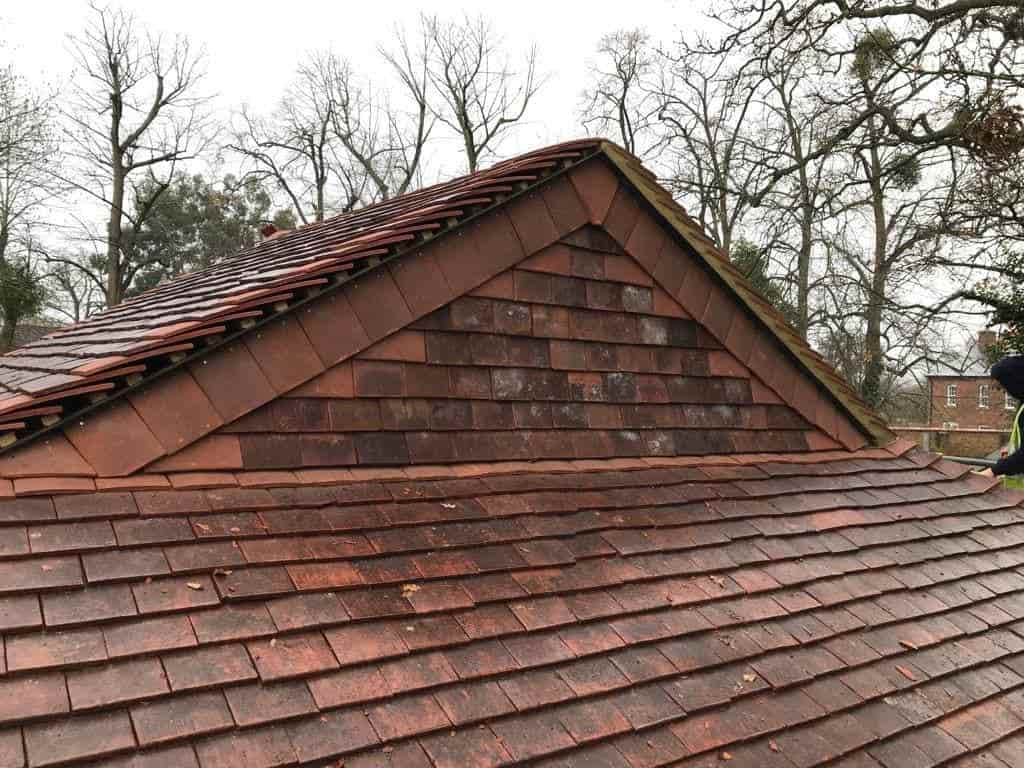
Every roof changes as it ages. Tiles or slates can deteriorate, fixings and roof details may become less reliable, and areas that have previously been repaired can begin requiring further attention. This does not mean that an older roof automatically needs replacing, as many localised defects can continue to be repaired successfully when the surrounding roof remains in suitable condition.
For property owners in Ashford, Kent, the more important question is whether problems are still isolated or whether deterioration has become widespread enough to affect the overall reliability of the roof. A single slipped tile or localised flashing defect is very different from repeated leaks, widespread deterioration and multiple roof components requiring attention.
Determining whether a roof has reached the end of its useful life therefore requires an assessment of the complete roof rather than relying on age or one visible problem alone.
What Are the Signs That an Older Roof May Need Replacing?
A roof may be approaching the end of its useful life when defects become widespread, repairs are repeatedly needed in different areas, water ingress continues to develop or several important components are deteriorating together.
No single sign automatically determines that replacement is necessary. The overall pattern matters.
Professional assessment can establish whether targeted repairs remain appropriate or whether continuing to repair individual sections is no longer addressing the wider condition of the roof.
Roof Age Alone Does Not Determine Its Condition
It can be tempting to assume that a roof needs replacing simply because it is old.
In reality, roofs of a similar age can be in very different conditions.
Materials, construction, previous maintenance, weather exposure and earlier repairs can all influence how a roof performs over time.
Some older roofs remain serviceable with occasional local repairs, while others develop widespread deterioration sooner.
Age provides useful context, but physical condition is considerably more important when deciding what work is required.
Repeated Roof Repairs Can Be an Important Warning Sign
An isolated repair is normal during the life of many roofs.
A slipped tile, damaged section of flashing or localised leak can often be addressed without affecting the remainder of the roof.
The situation changes when repairs become increasingly frequent.
If one section is repaired only for another problem to appear elsewhere, it may indicate that several components are reaching a similar stage of deterioration.
At this point, looking at the roof as a complete system becomes increasingly important.
Repairs in Different Areas Can Indicate Widespread Ageing
Repeated problems in exactly the same place can suggest that an underlying defect has not been fully resolved.
Problems developing across multiple unrelated areas can indicate something different.
For example, if tiles are deteriorating on several roof slopes while ridge details, flashing and other components are also requiring attention, the roof may be experiencing more general ageing.
Continuing to treat every defect independently can make it difficult to see the wider pattern.
A professional roof assessment brings these individual issues together.
Recurring Leaks Deserve Wider Investigation
A roof that repeatedly develops leaks should be assessed carefully.
The important distinction is whether the same unresolved leak keeps returning or whether new water ingress is appearing in different areas.
One persistent leak may still originate from a specific defect that can be repaired.
Several unrelated leaks can suggest that weather resistance is deteriorating across a wider part of the roof.
The history of water ingress therefore provides useful information when assessing overall roof condition.
Water Marks Do Not Always Reveal the Entry Point
Internal water staining can indicate a roof defect, but it does not necessarily show exactly where rainwater is entering.
Water can travel along roof components before becoming visible inside the property.
This means the external defect may be some distance from the internal damp patch.
Before deciding whether a roof requires repair or replacement, the source and route of the moisture should be investigated properly.
Otherwise, a repair may be carried out in the wrong place while the original defect remains.
Widespread Tile Deterioration Can Change the Decision
A few damaged tiles can often be replaced individually.
However, if large numbers of tiles are cracked, deteriorated, loose or repeatedly becoming displaced, local replacement may provide diminishing benefit.
The surrounding tiles matter just as much as those already showing obvious damage.
If numerous roof coverings are approaching a similar condition, repairing only the visibly failed ones can lead to repeated intervention as additional tiles deteriorate.
This broader pattern can indicate that the roof covering should be assessed as a whole.
Repeatedly Slipping Tiles Can Point to Problems Beneath Them
A slipped tile does not always mean that the tile itself has failed.
The fixing or supporting components beneath it may have deteriorated.
Where tiles repeatedly move within the same section, simply repositioning or replacing them may not address the underlying cause.
Professional inspection can determine whether the problem is confined to individual coverings or whether deterioration beneath them is affecting the reliability of the wider area.
The Condition Beneath the Roof Covering Matters
Tiles and slates are the most visible parts of many roofs, but they are not the entire construction.
Battens, underlay and other supporting components also contribute to roof performance.
If the external covering has experienced repeated defects over many years, some underlying materials may also have deteriorated.
This is why a roof can sometimes look relatively reasonable from ground level while requiring more substantial attention once its wider construction is assessed.
Deteriorated Underlay Can Influence Overall Reliability
Underlay provides an additional layer beneath the primary roof covering.
On an ageing roof, sections can deteriorate over time.
A small localised defect may sometimes be addressed as part of a targeted repair. More extensive deterioration can make localised work increasingly difficult because accessing one section may reveal that neighbouring material is also in poor condition.
The extent of the deterioration is therefore more important than the presence of one damaged area.
Battens Can Also Deteriorate
Roof battens support tiles or slates and help maintain their correct positioning.
Where battens have been affected by prolonged moisture or general deterioration, individual roof coverings may no longer remain as secure as expected.
If this problem is limited to one small area, localised work may be appropriate.
If deterioration extends across substantial sections, a wider roofing solution may need to be considered.
Ridge Problems Can Become Part of a Wider Pattern
Ridge tiles occupy one of the most exposed parts of many roofs.
An individual damaged ridge component can often be repaired.
However, extensive deterioration along the ridge combined with defects elsewhere may contribute to evidence that the roof is becoming less reliable overall.
The ridge should therefore be considered alongside the roof slopes, junctions and other details rather than treated as an entirely separate component.
Hip Details Can Deteriorate With the Rest of the Roof
On roofs incorporating hips, these junctions form important lines between different roof slopes.
Localised damage can often be repaired, but widespread deterioration may form part of the same ageing process affecting the rest of the roof.
When several major roof details require attention simultaneously, assessing the complete covering can provide a clearer understanding of what work is appropriate.
Flashing Can Become Increasingly Unreliable
Flashing is used around important roof junctions to help maintain weather resistance.
Over time, it can deteriorate or become defective.
One localised flashing problem does not mean a roof requires replacement.
However, if several flashing details are failing alongside deteriorating tiles and other ageing components, the combined condition becomes more significant.
This is why replacement decisions should consider the roof as a complete system.
Valleys Can Reveal Wider Roof Deterioration
Valleys carry concentrated rainwater where roof slopes meet.
Because they form important drainage routes, defects can lead to water ingress.
A damaged valley can sometimes be repaired independently.
If the surrounding roof coverings and supporting components are also extensively deteriorated, however, repairing the valley alone may not address the broader condition.
The relationship between the valley and adjoining roof sections should always be considered.
Previous Patch Repairs Can Tell a Story
An older roof may contain several areas where previous repairs have been carried out.
There is nothing inherently wrong with this. Effective local repairs can extend the serviceable life of a roof.
The concern arises when numerous patches accumulate and new problems continue developing between them.
At that point, the roof may consist of several repaired sections surrounded by increasingly unreliable original materials.
Reviewing the history and distribution of previous repairs can therefore help determine whether further patching remains sensible.
A Roof Can Reach a Point Where Repairs Become Reactive
There is an important difference between planned maintenance and repeatedly responding to failures.
A serviceable older roof may occasionally need a tile replaced or a specific detail repaired.
A deteriorating roof can begin demanding attention every time another weakness becomes apparent.
This reactive cycle can indicate that individual repairs are no longer addressing the fundamental issue: widespread ageing of the roof construction.
A broader assessment can help establish whether this stage has been reached.
Sagging or Changes in the Roofline Need Investigation
A pitched roof should generally maintain a consistent overall form.
Visible changes in the roofline, including noticeable dips or sagging sections, deserve professional assessment.
Such changes should not automatically be attributed to one particular cause without inspection.
The roof structure and surrounding components need to be considered together to establish what is happening and what response is appropriate.
Internal Signs Can Provide Important Clues
Not all indications of roof deterioration are visible externally.
Inside the property, signs may include:
- Recurring water staining
- Damp patches following rainfall
- Moisture appearing in more than one area
- Visible daylight through defects in accessible roof areas
- Dampness affecting roof timbers
- Evidence of previous water ingress
- Several areas showing signs of historical leakage
These observations should be considered alongside the external roof condition.
One Leak Does Not Mean a Roof Has Reached the End of Its Life
It is important not to overreact to an isolated problem.
Even a relatively significant leak can sometimes originate from one localised defect.
If the surrounding roof remains in suitable condition, repairing the source may restore reliable performance.
Replacement should therefore not be recommended purely because water has entered once.
The cause, extent and wider roof condition need to be understood first.
One Missing Tile Does Not Mean You Need a New Roof
The same principle applies to visible tile damage.
A missing, slipped or broken tile can often be repaired individually when surrounding materials remain sound.
Automatically recommending complete replacement for a minor isolated defect would ignore the actual condition of the majority of the roof.
Professional assessment should distinguish between localised damage and widespread failure.
Several Problems Occurring Together Are More Significant
The strongest indication that a roof may be approaching the end of its useful life is often not one dramatic defect but a combination of problems.
For example, an older roof might simultaneously have:
- Numerous deteriorating tiles
- Repeated slipped coverings
- Ageing ridge details
- Several flashing defects
- Recurring leaks
- Deterioration beneath the external covering
- Multiple previous repair areas
- Problems developing across different roof slopes
Each issue individually might be repairable.
Together, they can indicate that the roof’s overall reliability is declining.
The Extent of Deterioration Matters More Than One Defect
When deciding between repair and replacement, one of the most useful questions is: how much of the roof remains serviceable?
If the majority is in suitable condition and the defect is confined to one section, targeted repair may remain appropriate.
If deterioration affects numerous components across a substantial proportion of the roof, replacement may provide a more comprehensive solution.
This condition-based approach avoids making decisions based solely on age or appearance.
Roof Appearance Can Be Misleading
An ageing roof may look weathered while continuing to perform satisfactorily.
Conversely, a roof can appear reasonably uniform from ground level while containing deterioration that is not easily visible.
Appearance alone is therefore not a reliable way to determine remaining service life.
A closer assessment of roof coverings, details and accessible supporting components provides considerably more useful information.
Moss Does Not Automatically Mean a Roof Needs Replacing
Heavy moss growth can make an older roof look considerably worse than it actually is.
Its presence should not automatically be interpreted as evidence that the complete roof has failed.
The condition of the roofing materials beneath and around the growth remains the important consideration.
A roof replacement decision should be based on construction and performance rather than surface appearance alone.
Repairs Can Continue to Be Appropriate on an Older Roof
There is no reason to replace a roof purely because it has required occasional maintenance.
If problems remain genuinely localised and the surrounding materials continue to perform satisfactorily, repairs can remain a sensible approach.
The key is whether each repair restores a reliable section of roof or merely postpones another predictable failure nearby.
This distinction becomes increasingly important as a roof ages.
When Does Replacement Become the More Appropriate Approach?
Roof replacement becomes worth considering when deterioration is sufficiently widespread that localised repairs no longer address the overall condition effectively.
This might occur when numerous parts of the roof are approaching failure simultaneously or when substantial areas beneath the external covering also require attention.
Replacement allows the roof covering and relevant associated components to be approached comprehensively rather than continuing to work around multiple deteriorating sections.
A New Roof Can Address Several Related Problems Together
Where an ageing roof contains numerous defects, replacing the roof can provide an opportunity to address the wider construction as one project.
Instead of repairing individual areas as each develops a problem, the roof can be assessed systematically and renewed as appropriate.
This is fundamentally different from replacing a roof because of one isolated defect.
The decision should be justified by the extent and overall condition of the existing roof.
Professional Assessment Is Essential Before Deciding
Determining whether a roof has reached the end of its useful life requires more than looking at its age.
A professional assessment can consider:
- The condition of tiles or slates
- The number and distribution of damaged coverings
- Ridge and hip details
- Flashing
- Valleys
- Roof junctions
- Verges and eaves
- Previous repairs
- Evidence of recurring leaks
- Accessible underlay and battens
- Changes in the roofline
- The overall extent of deterioration
These observations provide a much stronger basis for deciding whether repairs remain suitable.
Repair Versus Replacement Is a Condition-Based Decision
There is no universal age at which every roof should automatically be replaced.
The most appropriate solution depends on how reliably the existing roof is still performing.
A relatively old roof with one localised defect may remain a good candidate for repair.
A roof with widespread deterioration and recurring failures across several sections may be a stronger candidate for replacement, even if no single defect appears particularly dramatic.
Understanding this distinction helps avoid both unnecessary replacement and excessive patching.
Why Finding the Root Cause Still Matters on an Older Roof
Even when a roof is clearly ageing, individual defects should still be diagnosed properly.
Repeated water ingress near one junction, for example, may originate from a specific repairable problem rather than indicating complete roof failure.
Likewise, several apparently unrelated symptoms may actually share one underlying cause.
Professional investigation helps establish what is genuinely failing before deciding how extensive the work should be.
Professional Roof Assessment in Ashford, Kent
At Ashford Roofing Services, we believe decisions about older roofs should be based on their actual condition rather than assumptions about age.
Where a defect is isolated and the surrounding roof remains serviceable, appropriate repair may be all that is required. Where deterioration has become widespread and several roof components are repeatedly causing problems, a more comprehensive approach may be appropriate.
For property owners in Ashford, Kent, a professional roof assessment can provide a clearer understanding of whether continued repairs remain practical or whether the roof has reached a stage where replacement should be considered.
Conclusion
A roof has usually reached the end of its useful life when deterioration is no longer confined to individual areas and the overall reliability of the roof has significantly declined. Repeated leaks, widespread tile deterioration, failing roof details, problems beneath the external covering and numerous previous repairs can collectively indicate that localised work is becoming less effective.
However, age, one leak or a small number of damaged tiles should not automatically lead to roof replacement. Many older roofs can continue performing effectively when defects are genuinely isolated and suitable for professional repair.
The most reliable way to decide is to assess the roof as a complete system, establish the extent of deterioration and determine whether repairs can still provide a satisfactory long-term result.
If you are concerned about the condition of an older roof in Ashford, Kent, contact Ashford Roofing Services. We can assess the roof, identify the extent of any deterioration and recommend an appropriate approach based on what the roof actually requires.
Call us on: 01233 542397
Click here to find out more about Ashford Roofing Services
Click here to complete our contact form and see how we can help with your roofing needs.